How Machine Learning Models Spot Irregularities in Mobile Payment Streams for E-commerce Merchants
Written by Devon Braun · Jul 26, 2026

How Machine Learning Models Spot Irregularities in Mobile Payment Streams for E-commerce Merchants
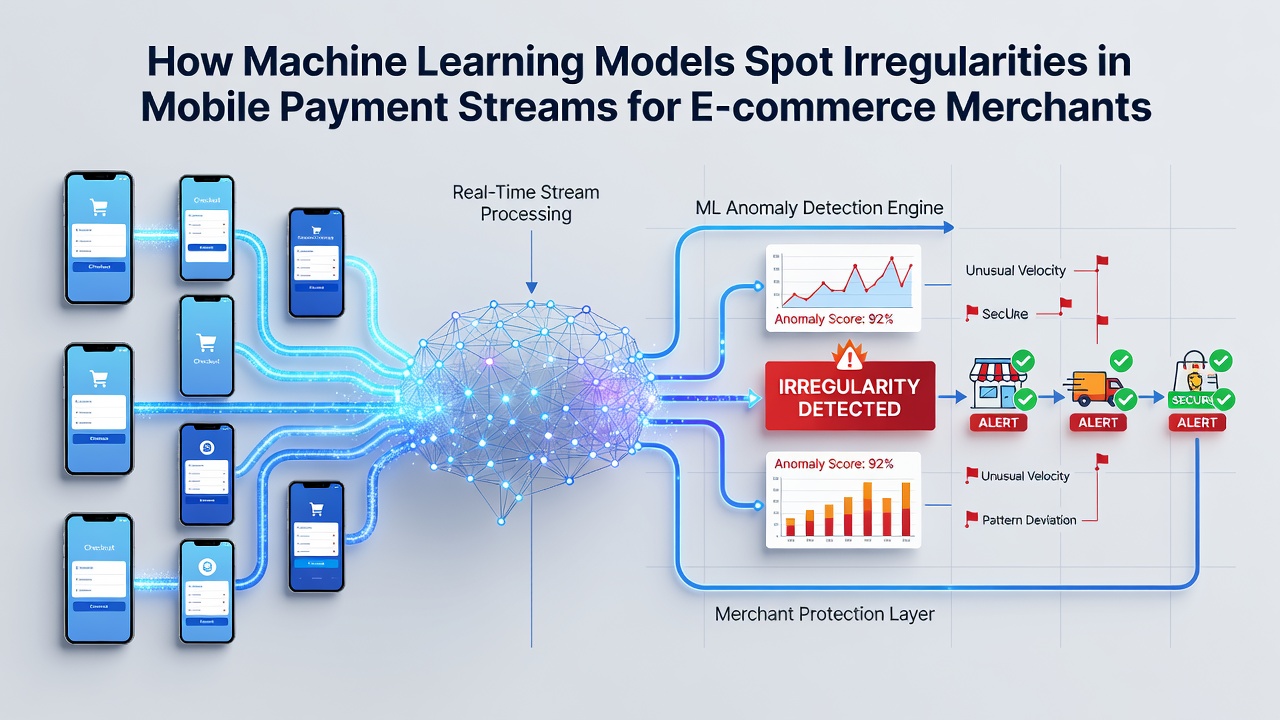
Merchants who process mobile payments face constant pressure to separate legitimate purchases from suspicious activity, and machine learning systems now handle much of that filtering by examining transaction streams in real time. These models ingest data points such as device identifiers, geolocation coordinates, purchase amounts, and behavioral sequences, then flag patterns that deviate from established customer norms. Research from academic institutions shows that anomaly detection improves when algorithms train on both historical records and live feeds, allowing systems to adapt as fraud tactics evolve.
Data Inputs That Feed the Models
Mobile payment streams carry rich signals because each transaction arrives with metadata from smartphones and tablets. Device fingerprinting captures operating system versions, screen resolutions, and sensor readings, while network details reveal whether traffic originates from cellular towers or public Wi-Fi hotspots. Location services add latitude and longitude values that can be cross-checked against a user's typical travel radius. Payment velocity metrics track how many attempts occur within short windows, and time-of-day distributions highlight whether activity aligns with past habits for that account.
Core Techniques Behind Anomaly Detection
Supervised classifiers such as gradient-boosted trees learn from labeled examples where investigators previously marked transactions as fraudulent or clean. Unsupervised methods including isolation forests and variational autoencoders identify outliers without prior labels by measuring how much each new record differs from the dense regions of normal data. Sequence models based on recurrent networks examine the order of actions within a session, spotting abrupt shifts such as a sudden change from browsing to high-value checkout that contradicts earlier patterns. Ensemble approaches combine several of these methods so that weaknesses in one algorithm are offset by strengths in others, and studies indicate this layering reduces false positives while maintaining high recall rates.
Processing Speed and Integration Points
Real-time scoring occurs at the payment gateway or inside the merchant's risk engine, where models evaluate each authorization request before funds move. Low-latency architectures push feature vectors through optimized inference pipelines that return risk scores in under 100 milliseconds, meeting the demands of mobile checkout flows. When scores exceed thresholds, systems trigger additional verification steps such as one-time passcodes or step-up authentication, and declined transactions feed back into the training loop so that subsequent models refine their boundaries. Observers note that integration with inventory and order management tools allows merchants to pause fulfillment automatically when irregularities surface, limiting exposure before goods ship.
Geographic and Temporal Pattern Analysis
Models also compare current activity against broader population baselines drawn from aggregated, anonymized datasets. A sudden cluster of transactions from a single mobile carrier in one region can trigger review if it departs from historical distributions for that merchant. Time-zone mismatches between device settings and IP addresses add another layer of scrutiny, while holiday shopping spikes in July 2026 are expected to test these systems further as volume surges during major sales events. According to findings published by the National Institute of Standards and Technology, temporal feature engineering that accounts for seasonal cycles improves detection accuracy across multiple retail categories.
Adaptation to Emerging Threats
Fraudsters continually test new attack vectors, and machine learning pipelines respond through continuous retraining cycles that incorporate recent incidents. Transfer learning lets models trained on one merchant's data bootstrap performance for smaller retailers who lack extensive histories. Collaborative frameworks among payment processors allow shared threat intelligence without exposing individual customer records, and regulatory guidance from bodies such as the European Central Bank encourages such cooperation while requiring strict data governance. The result is a moving equilibrium where detection rates stay ahead of evolving tactics.
Conclusion
Machine learning models now form a central layer of defense for e-commerce merchants handling mobile payments by continuously evaluating streams of transaction data against learned representations of normal behavior. Their effectiveness stems from diverse inputs, layered algorithms, and rapid feedback mechanisms that keep pace with both legitimate growth and fraudulent innovation. As mobile commerce expands, these systems remain essential for maintaining trust and operational continuity across global retail networks.